
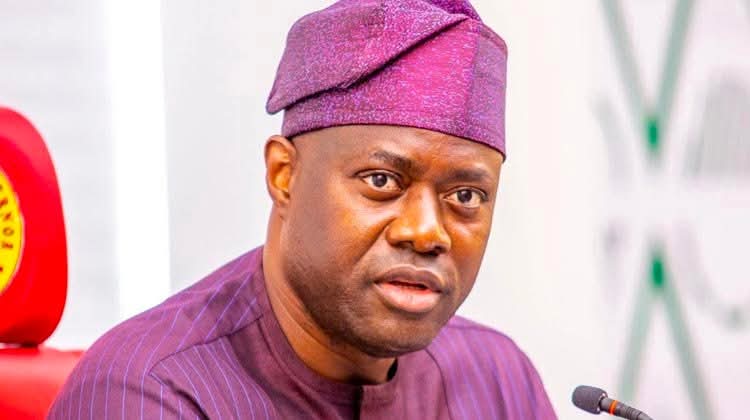

Recently, Governor Seyi Makinde publicly admitted that he regretted supporting President Bola Ahmed Tinubu in the 2023 Nigerian presidential election. This candid acknowledgment marks a political thesis — a starting point that opened the door for public reflection and debate. It is a rare moment when a leader steps forward to recognize a miscalculation, setting the stage for accountability and introspection.
The antithesis emerged immediately through the voice of former Governor Ayo Fayose, who claimed that Governor Makinde had received ₦50 billion from the Federal Government as intervention funds following the Bodija Housing Estate disaster. This allegation challenged the governor’s credibility and raised serious questions about transparency in the management of public resources. While the claim made waves in public discourse, the Oyo State Government clarified that the actual sum released was ₦30 billion, not ₦50 billion, highlighting the gap between perception and reality.

The synthesis, then, is not a tidy resolution but a moment of truth: a call for clarity, accountability, and responsible leadership. Governor Makinde has taken the first step by acknowledging his political misstep, and the official clarification of funds is a step toward transparency. However, the real test lies in how he addresses the people directly, explaining in detail how the intervention funds were used. The public deserves nothing less.
It is imperative that Governor Makinde comes forward with a full accounting of the ₦30 billion. As the proverb reminds us, “He who seeks equity must do equity.” The citizens of Oyo State entrusted him with their mandate, their hopes, and their votes. To uphold that trust, he must be open, honest, and forthcoming, showing that leadership is not merely about popularity or sympathy, but about responsibility, stewardship, and justice.
This situation also illustrates a broader truth: the friction between political actors can sometimes serve the public good. The differences between Governor Makinde and former Governor Fayose have exposed facts that might have otherwise remained hidden. In a functioning democracy, such tensions are not distractions — they are opportunities for greater transparency, accountability, and citizen empowerment.
Yet, beyond the political drama, there remains a pressing social concern: did the intended beneficiaries of the intervention actually receive help? Bodija Housing Estate, an area considered affluent, still leaves many questioning whether the intervention translated into tangible support for residents affected by the disaster. Governance is measured not only by declarations but by impact on the lives of the people.
As citizens, we must hold leaders to account while also recognizing that the journey toward good governance is incremental, shaped by both action and correction. Governor Makinde has a chance to set a precedent: to lead by example, transparency, and integrity, ensuring that public resources serve their intended purpose and that public trust is reinforced.
As the saying goes:
“Accountability is the soul of good governance.”
This is a defining moment for leadership in Oyo State. It reminds us that democracy thrives not in the absence of mistakes but in the courage to admit them, the willingness to rectify them, and the commitment to serve the people faithfully.
Not yet Uhuru.
– ‘Jide Alofe
An advocate, a PR expert, a media consultant, a brand strategist, a hospitality entrepreneur, a real estate investor, and a leadership coach.
About the Author